|
|
| Caldecott Medal Winners | 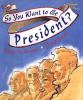 | | So You Want to be President
by David Small
Publishers Weekly
: HThis lighthearted, often humorous roundup of anecdotes and trivia is cast as a handbook of helpful hints to aspiring presidential candidates. St. George (Sacagawea; Crazy Horse) points out that it might boost your odds of being elected if your name is James (the moniker of six former presidents) or if your place of birth was a humble dwelling ("You probably weren't born in a log cabin. That's too bad. People are crazy about log-cabin Presidents. They elected eight"). She serves up diverse, occasionally tongue-in-cheek tidbits and spices the narrative with colorful quotes from her subjects. For instance, she notes that "Warren Harding was a handsome man, but he was one of our worst Presidents" due to his corrupt administration, and backs it up with one of his own quotes, "I am not fit for this office and never should have been here." Meanwhile, Small (The Gardener) shows Harding crowned king of a "Presidential Beauty Contest"; all the other presidents applaud him (except for a grimacing Nixon). The comical, caricatured artwork emphasizes some of the presidents' best known qualities and amplifies the playful tone of the text. For an illustration of family histories, Small depicts eight diminutive siblings crawling over a patient young George Washington; for another featuring pre-presidential occupations, Harry Truman stands at the cash register of his men's shop while Andrew Johnson (a former tailor) makes alterations on movie star Ronald Reagan's suit. The many clever, quirky asides may well send readers off on a presidential fact-finding missionDand spark many a discussion of additional anecdotes. A clever and engrossing approach to the men who have led America. Ages 7-up. (Aug.) Copyright 2000 Cahners Business Information, Inc. Distributed by Syndetic Solutions Inc. Terms
School Library Journal
: Gr 4-8-Curious tidbits of personal information and national history combine with humorously drawn caricatures to give this tongue-in-cheek picture book a quirky appeal. "There are good things about being President and there are bad things about being President." So begins a walk through a brief history of facts, successes, oddities, and mishaps. For example, most readers won't know that William Howard Taft weighed over 300 pounds and ordered a specially made bathtub. Small's drawing of a naked Taft being lowered into a water-filled tub by means of a crane should help them remember. Another spread depicts a men's shop where Andrew Johnson (a tailor) fits Ronald Reagan (an actor) for a suit while Harry Truman (a haberdasher) stands behind the counter. While the text exposes the human side of the individuals, the office of the presidency is ultimately treated with respect and dignity. A list of presidents with terms of office, birthplace, date of birth and death, and a one-sentence summary of their accomplishments is provided. This title will add spark to any study of this popular subject.-Alicia Eames, New York City Public Schools Copyright 2000 Cahners Business Information, Inc. Distributed by Syndetic Solutions Inc. Terms
|
| Newbery Medal Winners |  | | The Graveyard Book
by Neil Gaiman
Publishers Weekly
: Starred Review. A lavish middle-grade novel, Gaiman's first since Coraline, this gothic fantasy almost lives up to its extravagant advance billing. The opening is enthralling: There was a hand in the darkness, and it held a knife. Evading the murderer who kills the rest of his family, a child roughly 18 months old climbs out of his crib, bumps his bottom down a steep stairway, walks out the open door and crosses the street into the cemetery opposite, where ghosts take him in. What mystery/horror/suspense reader could stop here, especially with Gaiman's talent for storytelling? The author riffs on the Jungle Book, folklore, nursery rhymes and history; he tosses in werewolves and hints at vampires—and he makes these figures seem like metaphors for transitions in childhood and youth. As the boy, called Nobody or Bod, grows up, the killer still stalking him, there are slack moments and some repetition—not enough to spoil a reader's pleasure, but noticeable all the same. When the chilling moments do come, they are as genuinely frightening as only Gaiman can make them, and redeem any shortcomings. Ages 10–up. (Oct.) Copyright © Reed Business Information, a division of Reed Elsevier Inc. All rights reserved. Distributed by Syndetic Solutions Inc. Terms
School Library Journal
: Gr 5–8—Somewhere in contemporary Britain, "the man Jack" uses his razor-sharp knife to murder a family, but the youngest, a toddler, slips away. The boy ends up in a graveyard, where the ghostly inhabitants adopt him to keep him safe. Nobody Owens, so named because he "looks like nobody but himself," grows up among a multigenerational cast of characters from different historical periods that includes matronly Mistress Owens; ancient Roman Caius Pompeius; an opinionated young witch; a melodramatic hack poet; and Bod's beloved mentor and guardian, Silas, who is neither living nor dead and has secrets of his own. As he grows up, Bod has a series of adventures, both in and out of the graveyard, and the threat of the man Jack who continues to hunt for him is ever present. Bod's love for his graveyard family and vice versa provide the emotional center, amid suspense, spot-on humor, and delightful scene-setting. The child Bod's behavior is occasionally too precocious to be believed, and a series of puns on the name Jack render the villain a bit less frightening than he should be, though only momentarily. Aside from these small flaws, however, Gaiman has created a rich, surprising, and sometimes disturbing tale of dreams, ghouls, murderers, trickery, and family.—Megan Honig, New York Public Library Copyright © Reed Business Information, a division of Reed Elsevier Inc. All rights reserved. Distributed by Syndetic Solutions Inc. Terms
|
| Oprah's Book Club |  | | A Million Little Pieces
by James Frey
Publishers Weekly
: Frey is pretender to the throne of the aggressive, digressive, cocky Kings David: Eggers and Foster Wallace. Pre-pub comparisons to those writers spring not from Frey's writing but from his attitude: as a recent advance profile put it, the 33-year-old former drug dealer and screenwriter "wants to be the greatest literary writer of his generation." While the Davids have their faults, their work is unquestionably literary. Frey's work is more mirrored surface than depth, but this superficiality has its attractions. With a combination of upper-middle-class entitlement, street credibility garnered by astronomical drug intake and PowerPoint-like sentence fragments and clipped dialogue, Frey proffers a book that is deeply flawed, too long, a trial of even the most na?ve reader's credulousness-yet its posturings hit a nerve. This is not a new story: boy from a nice, if a little chilly, family gets into trouble early with alcohol and drugs and stays there. Pieces begins as Frey arrives at Hazelden, which claims to be the most successful treatment center in the world, though its success rate is a mere 17%. There are flashbacks to the binges that led to rehab and digressions into the history of other patients: a mobster, a boxer, a former college administrator, and Lilly, his forbidden love interest, a classic fallen princess, former prostitute and crack addict. What sets Pieces apart from other memoirs about 12-stepping is Frey's resistance to the concept of a higher power. The book is sure to draw criticism from the recovery community, which is, in a sense, Frey's great gimmick. He is someone whose problems seem to stem from being uncomfortable with authority, and who resists it to the end, surviving despite the odds against him. The prose is repetitive to the point of being exasperating, but the story, with its forays into the consciousness of an addict, is correspondingly difficult to put down. Copyright 2003 Reed Business Information, Inc. Distributed by Syndetic Solutions Inc. Terms
School Library Journal
: Adult/High School-Frey's high school and college years are a blur of alcohol and drugs, culminating in a full-fledged crack addiction at age 23. As the book begins, his fed-up friends have convinced an airline to let him on the plane and shipped him off to his parents, who promptly put him in Hazelden, the rehabilitation clinic with the greatest success rate, 20 percent. Frey doesn't shy away from the gory details of addiction and recovery; all of the bodily fluids make major appearances here. What really separates this title from other rehab memoirs, apart from the author's young age, is his literary prowess. He doesn't rely on traditional indentation, punctuation, or capitalization, which adds to the nearly poetic, impressionistic detail of parts of the story. Readers cannot help but feel his sickness, pain, and anger, which is evident through his language. Ken Kesey's One Flew over the Cuckoo's Nest (Viking, 1962) seems an apt comparison for this work-Frey maintains his principles and does not respect authority at all if it doesn't follow his beliefs. And fellow addicts are as much, if not more, help to him than the clinicians who are trying to preach the 12 steps, which he does not intend to follow in his path to sobriety. This book is highly recommended for teens interested in the darker side of human existence.-Jamie Watson, Enoch Pratt Free Library, Baltimore Copyright 2003 Reed Business Information, Inc. Distributed by Syndetic Solutions Inc. Terms
|
|

